
It was a first-of-its-kind finish in Ohio as Confetti floated through the air at SPIRE Academy as two young athletes stepped forward to accept the first championship trophies in Patriot Games history.
Kennadi Fuhrman of Kansas and Rockwell Myers of Utah had reached the finish of an uncommon athletic journey. They began among 120 teenagers representing states, territories, tribal nations and other American communities. Three days later, after individual fitness tests, team competitions, endurance circuits and a final obstacle course, they stood together as the inaugural champions.
Each winner received a $125,000 college scholarship, evenly dividing the Games’ $250,000 scholarship pool. President Donald Trump joined the closing presentation, helping award the championship trophies and oversized scholarship checks as fellow competitors looked on.
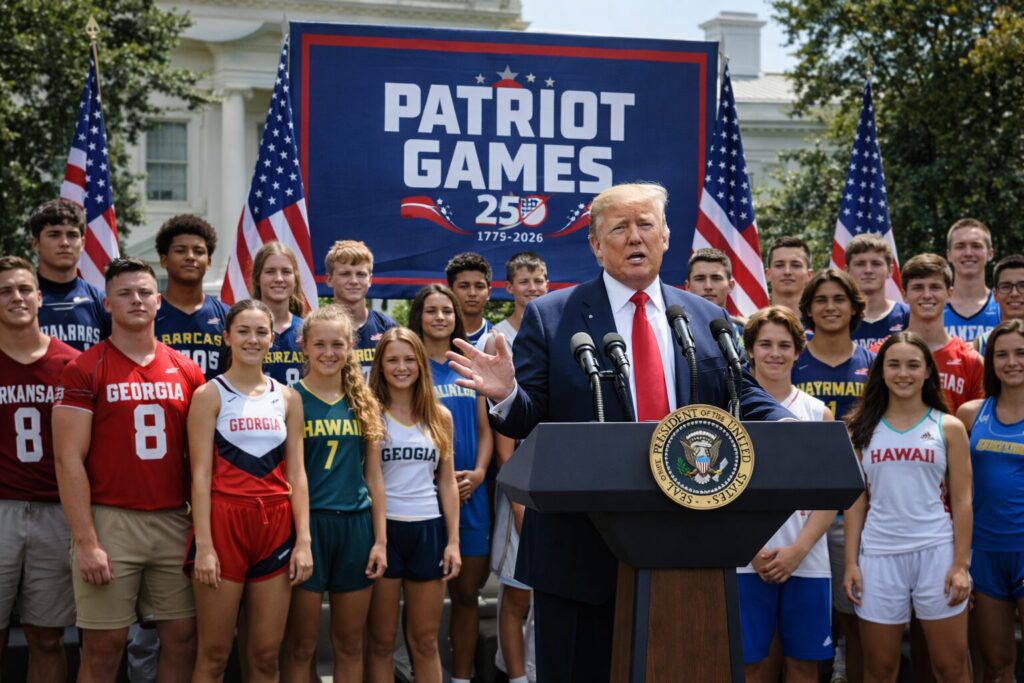
The moment completed an idea President Trump had introduced as part of Freedom 250, the national program created around America’s 250th anniversary. What began as a proposal for a nationwide youth competition ultimately became more than 26 hours of streamed athletic coverage, a primetime ABC special and a new platform for teenage competitors from across the country.
Fuhrman and Myers left Ohio with the event’s largest prizes. The other 118 athletes departed with something less easily measured: national exposure, new friendships and the distinction of participating in the first edition of an event that had never existed before.
Meet the First Patriot Games Champions
Kennadi Fuhrman: Kansas Strength and Soccer Instincts
Kennadi Fuhrman represented Kansas and entered the Patriot Games with an accomplished soccer background. She is a defender for De Soto High School, where her anticipation, positioning and defensive discipline have helped anchor one of the state’s prominent girls soccer programs.
During De Soto’s 2026 season, Fuhrman was listed among the key players on a team that entered the state quarterfinals with a 15-1-2 record. She had also contributed five goals, demonstrating that her game extended beyond defensive work.
Those soccer qualities translated naturally to the Patriot Games. The competition asked athletes to change direction quickly, read unfamiliar situations and continue performing across multiple disciplines. Fuhrman advanced through the early events, survived the narrowing field and completed the final obstacle course faster than the other female finalists.
After the victory, she credited her faith and the support behind her achievement. Her championship also gave Kansas the first female title in the Games’ record book.
Rockwell Myers: Utah Tennis, Dance and Determination
Rockwell Myers represented Utah and brought one of the competition’s most intriguing athletic combinations: tennis and ballroom dancing.
Tennis develops speed, hand-eye coordination, balance and the ability to make rapid adjustments. Ballroom dancing adds rhythm, footwork, body control and the discipline required to perform precise movements under pressure. Together, those skills proved well suited to an all-around competition that rewarded adaptability rather than specialization.
Myers advanced through the individual and team rounds before securing his place among the final male competitors. He then completed the championship course to become the first male Patriot Games champion.
Afterward, Myers described the experience as a powerful learning opportunity and spoke about the importance of placing his faith first. His victory made Utah part of the competition’s opening chapter and demonstrated the value of athletic range in a field filled with competitors from many sporting backgrounds.
How 120 Athletes Became Eight Finalists
The Patriot Games were designed to identify more than the fastest runner or strongest individual competitor. The structure rewarded speed, endurance, agility, coordination, teamwork and the ability to perform in unfamiliar events.
The 120 athletes were ages 14 to 17. The representation model called for one young man and one young woman from each state and territory, supplemented by athletes connected to tribal nations, military communities and other participating American jurisdictions.
The first day opened with boys’ and girls’ Presidential Qualifiers. Those tests drew upon the tradition of the Presidential Fitness Test and established an early measure of all-around conditioning.
The afternoon introduced team play through kickball and dodgeball. These events required athletes who had recently met to organize quickly, communicate and contribute to a shared result. A competitor’s path through the Games therefore depended on more than an individual time or score.
Day two raised the physical demands with the Varsity Circuit and Operation Endurance. The military-inspired endurance course included tire tosses, monkey bars, a balance beam and net climbing. Athletes had to combine strength with coordination while maintaining momentum from one station to the next.
The third day featured tug of war and Victory Hoops, an arcade-style basketball shooting competition. By this point, the field had been reduced to 16 boys and 16 girls. Further elimination rounds produced eight overall finalists—four young men and four young women—who advanced to the closing-night obstacle course.
The final course delivered the event’s most complete test. Competitors swung from ropes, carried kettlebells, climbed a wall and navigated a sequence that demanded both strategy and sustained athletic effort. Fuhrman and Myers produced the winning performances.
Discover DC Now“America’s next chapter began with 120 athletes, eight finalists and two champions.”
President Trump Joins the Closing Celebration
President Trump traveled to Northeast Ohio on August 11 for the championship program. Air Force One landed at Cleveland Hopkins International Airport at approximately 4:45 p.m. amid heavy rain. Trump and ESPN personality Pat McAfee then traveled aboard Marine One to Ashtabula County and SPIRE Academy.
Inside the venue, the president watched as the finalists moved through the obstacle course. His appearance connected the competition’s closing night directly to the original Freedom 250 vision he had announced months earlier.
Trump also sat for an onstage interview with ESPN host Laura Rutledge. Speaking about the athletes and the atmosphere, he said he was proud of the group and the spirit they displayed.
After the final results were determined, Trump joined the presentation of the trophies and scholarship checks. Confetti marked the official close of the competition, and the evening ended on a lighter note as the president performed his familiar dance to “Y.M.C.A.” alongside participants.
The crowd greeted his arrival with chants of “USA,” while a nearby scoreboard displayed 45-47—a reference to Trump’s service as the 45th and 47th president.
The Scholarships Behind the Celebration
The $250,000 prize pool gave the Games a purpose extending beyond trophies and television.
Fuhrman and Myers each received $125,000 in college scholarship funding. The awards are intended to support the champions’ educational goals and create opportunities that continue long after the final competition.
That distinction matters. A trophy recognizes what an athlete accomplished over three days. A scholarship invests in what that athlete might accomplish over the next several years.
The educational component also fit naturally with SPIRE Academy, an accredited college-preparatory boarding school and athletic-development campus. The Ohio complex offered facilities capable of accommodating the many events while reinforcing the Games’ connection between athletic achievement and future preparation.
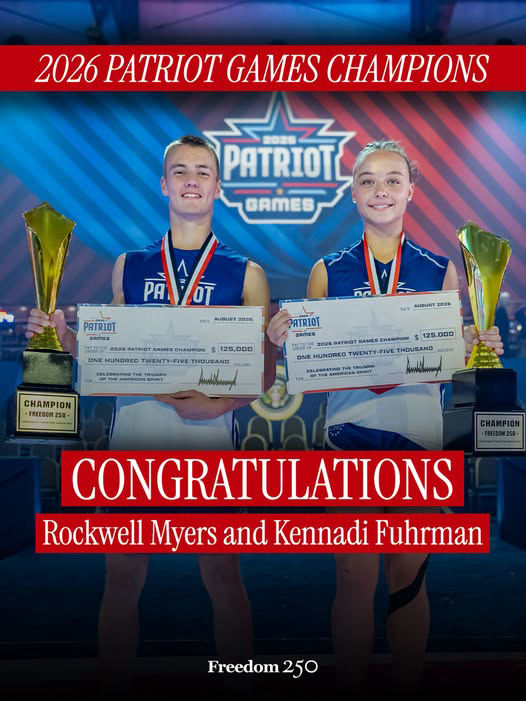
Freedom 250 Patriot Games Champions
Kansas representative Kennadi Fuhrman and Utah representative Rockwell Myers celebrate after becoming the first Patriot Games champions.
Early Impressions of the Inaugural Games
The most encouraging impressions came from the athletes themselves. Competitors shared videos of their arrival, commemorative gear and experiences meeting teammates from other parts of the country. The closing program showed finalists congratulating one another as the competition moved toward its final result.
Post-event coverage also noted the cheerful competitors and wholesome interactions that appeared throughout the Games. Those moments gave the event a personality beyond its leaderboard.
The team contests were especially important in establishing that atmosphere. Athletes arrived carrying individual state or community identities, but kickball, dodgeball and tug of war required them to create new alliances. The structure repeatedly placed cooperation beside competition.
Local leaders also welcomed the national visibility generated by the Games. SPIRE Academy’s large campus became a broadcast backdrop, while Geneva and surrounding Ashtabula County hosted athletes, families, production teams and visitors connected to the event.
What Was New About the Patriot Games?
As an inaugural event, the entire concept was new—but several features distinguished it from a conventional high school championship.
First, the athletes did not qualify through one shared sport. Soccer players, runners, basketball players, tennis players and competitors from other disciplines met in an all-around format.
Second, the Games combined individual and team scoring. Athletes had opportunities to demonstrate personal fitness, but they also had to contribute to newly assembled teams.
Third, the selection process considered the applicants’ stories. Prospective competitors submitted eligibility information and videos explaining why they wanted to represent their communities.
Finally, the prizes were educational. Instead of a professional contract or cash purse, the championship carried scholarship funding intended to support the winners’ next chapters.
These features gave the Games elements of a track meet, team tournament, fitness competition and televised youth showcase without fully belonging to any single category.
More Than the Final Score
Fuhrman and Myers earned their places in history as the first champions, but the Patriot Games also created 120 individual stories.
For some participants, the event provided a first experience with national television production. For others, it was an opportunity to compete outside their primary sport. Many met peers from states and territories they had never visited.
That lesson was visible throughout the three days. A soccer defender became a national all-around champion. A tennis player and ballroom dancer found the right combination of speed, coordination and composure to win an obstacle-course final.
That lesson was visible throughout the three days. A soccer defender became a national all-around champion. A tennis player and ballroom dancer found the right combination of speed, coordination and composure to win an obstacle-course final.
Their victories reflected the defining quality of the inaugural Games: versatility.
Final Word
The first Patriot Games began with 120 young athletes and ended beneath a shower of confetti, with two champions holding trophies and scholarship checks.
Between those moments came qualifiers, tire tosses, kickball games, balance beams, basketball shots, team huddles and an obstacle course that decided the final standings.
President Trump’s presence at the finale gave the closing program a direct connection to the Freedom 250 vision that launched the competition. Yet the enduring images belong to the athletes: teenagers wearing the names of their states and communities, encouraging teammates and attempting challenges outside their usual sports.
Kennadi Fuhrman and Rockwell Myers leave the inaugural Patriot Games as champions and recipients of substantial educational opportunities. Their fellow competitors leave as members of an exclusive first class—the 120 young Americans who established what the Patriot Games could become.
America’s 250th anniversary is a commemoration of what the country has already achieved. In Ohio, the Patriot Games offered a reminder that anniversaries can also look forward.
The next chapter began with a starting line, eight finalists, two champions and a generation ready to step into the arena.